Facebook
 Twitter

Alex Presland
Basic Pleskian
Username:
TITLE
Plesk password reset email for an email account bounced by IONOS
PRODUCT, VERSION, OPERATING SYSTEM, ARCHITECTURE
Plesk Obsidian v18.0.81_build1800261111.12 os_Ubuntu 22.04. CPU = AMD EPYC 7571 (AWS)
PROBLEM DESCRIPTION
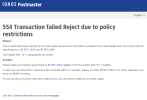
A user's password reset emails weren't getting through. I investigated and found an error message in /var/log/maillog:
status=bounced (host mx00.ionos.co.uk[212.227.15.171] said: 554-Transaction failed 554-Reject due to policy restrictions. 554 For explanation visit 554 Transaction failed Reject due to policy restrictions
STEPS TO REPRODUCE
Have a user whose external email address is hosted on IONOS. Trigger a password reset on their account.
ACTUAL RESULT
User doesn't get the password reset email because it is summarily rejected by IONOS, citing that it is not formatted correctly.
EXPECTED RESULT
Email is successfully delivered to the user, so that they can reset their email account password
ANY ADDITIONAL INFORMATION
None at present.
YOUR EXPECTATIONS FROM PLESK SERVICE TEAM
Confirm bug