• The new Python extension is now available. It allows customers to deploy and manage WSGI-based Python applications on their websites directly from Plesk.
  • Debian 11 has reached its end-of-life (vendor EOL date - August 31, 2026). Plesk Obsidian 18.0.81 is the last release to support it.
    If you are running Plesk Obsidian on Debian 11, we recommend you upgrade those servers to Debian 12 using our dist-upgrade tool.
  • We plan to deprecate and remove the support for XML RPC protocol versions earlier than 1.6.9.1 in Plesk Obsidian 18.0.82. We strongly recommend that you update all existing integrations using earlier versions of the XML RPC protocol to comply with the version 1.6.9.1 specification.

Question ETA for critical PHP security updates (CVE-2026-109618 / CVE-2026-109619)?

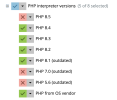
The PHP 7.4 and 8.0 versions are no longer available in the component selection. They are still installed on the server, but the updater doesn't pick up any updates. Does anybody know what could be wrong?
 

Attachments

  • Scherm­afbeelding 2026-10-21 om 20.52.35.png
    Scherm­afbeelding 2026-10-21 om 20.52.35.png
    63.6 KB · Views: 1
Hello,
if anyone is not receiving updates and is hosting with STRATO, change the mirror URLs in plesk.list from the STRATO mirrors to autoinstall.plesk.com.
 
Yes, Plesk packages a seperate version of PHP for use with its own services. To date these have not been updated so while websites running on an updated Plesk server are no longer vulnerable, Plesk effectively still is until the version is updated.

If you run this and it comes back with PHP 8.4.25, then the Plesk panel itself becomes the attack vector:

/usr/local/psa/admin/bin/php -v

A release to address this as soon as possible would help to close that gap.
 
Back
Top