• The new Python extension is now available. It allows customers to deploy and manage WSGI-based Python applications on their websites directly from Plesk.
  • The Plesk Mobile apps for iOS and Android and the Plesk Mobile Center extension have been deprecated, and are no longer available for new installations. In Plesk Obsidian 18.0.84, the Plesk Mobile Center extension will be removed from servers during the upgrade, and the Plesk Mobile apps will lose their server management features.
  • The Social Login extension has been deprecated and will be removed in Plesk Obsidian 18.0.84. After that, it will no longer be possible to log in to Plesk with a Google, Facebook, GitHub account, or with a passkey. Plesk usernames and passwords, as well as logging in with a WebPros Account, are not affected.

Question ETA for critical PHP security updates (CVE-2026-109618 / CVE-2026-109619)?

Might been daily task running before the used CDN server had the updated info, but that is just a guess at the moment :)
Anyway triggering the installer manually finds it
Only Tools & Settings → Updates → Components works.

The “Check for Updates” button on the Plesk home page did not indicate that an update was available.

Even under Tools & Settings → Updates → Install or Update Product, the update was not listed as available.

However, I was able to find and install the update through Tools & Settings → Updates → Components.
 
The only responsible thing for plesk would be to update older versions since they supply them. We pay a lot of money per month for this control panel, the bare minimum we expect are security fixes for such a critical vulnerability. If DirectAdmin can do it, so can you.
 
Hello Plesk Team,

We are running a business-critical production server with the following configuration:

  • AlmaLinux 9
  • Plesk Obsidian 18.0.79 Update 11
  • sw-engine PHP 8.4.22
  • MariaDB 10.11.19
  • Website PHP versions already patched to 8.3.36 and 8.5.12
We have temporarily blocked public access to the Plesk administration ports at the provider firewall due to the critical PHP vulnerabilities.

According to the security advisory, sw-engine fixes are currently available only for 18.0.80 Update 11 and 18.0.81 Update 4.

Could someone from the Plesk team please confirm:

  1. Will there be an official security hotfix or backport for 18.0.79 Update 11?
  2. If not, is an upgrade directly from 18.0.79 Update 11 to 18.0.81 Update 4 officially supported?
  3. Can we upgrade without changing the MariaDB 10.11 major version?
  4. Are there any known compatibility issues or special precautions regarding the new SFTP functionality?
  5. Is restoring a full server backup created with 18.0.79 to a clean 18.0.81 installation supported?
Unfortunately, our dedicated server provider does not offer a usable full-system snapshot or rollback mechanism. We have external Plesk backups, but cannot safely roll back an in-place upgrade.

We are considering an emergency maintenance window on 23 October 2026 at approximately 14:00 CEST.

An official clarification would be greatly appreciated before proceeding.

Thank you.
Torsten
 
@Torsten Leier

Will there be an official security hotfix or backport for 18.0.79 Update 11?

no

If not, is an upgrade directly from 18.0.79 Update 11 to 18.0.81 Update 4 officially supported?

yes

Can we upgrade without changing the MariaDB 10.11 major version?

yes

Are there any known compatibility issues or special precautions regarding the new SFTP functionality?

no

Is restoring a full server backup created with 18.0.79 to a clean 18.0.81 installation supported?

yes
 
Just finished migrating the last problematic domains to a new Debian 13 server wPlesk 18..0.81#4.

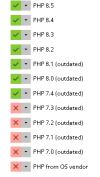
Plesk installer still offers PHP 7.0-7.3 to be installed. If there's no patch for these versions I don't think they should be made available to install outside the Tuxcare extension. Or marked them differently than the patched 7.4-8.1 versions:

1792682922879.png
 
@JVG In my installer I have only 7.4 and above. But 7.4 has been fixed and also 7.1 in my case (I installed it from sury.org).
 
Ive updated my servers to php 8.3.36 but when I run this scanner it goes out of memory


22100#0: *22665 FastCGI sent in stderr: "PHP message: PHP Fatal error: Allowed memory size of 134217728 bytes exhausted (tried to allocate 2097152 bytes) in Unknown on line 0" while reading response header from upstream

22100#0: *22665 upstream sent unexpected FastCGI record: 3 while reading response header from upstream

Also the build date says:
/opt/plesk/php/8.3/bin/php -i | grep -i "build date"
Build Date => Oct 21 2026 08:04:57

isnt this before the patch release?
 
Guys there is another unpatched PHP RCE: CVE-2026-115560. Make sure to set `session.upload_progress.enabled=0` in all your PHP.ini files:
but read the article linked first.

only exploitable under very unusual combination of configuration and application code.
 
Guys there is another unpatched PHP RCE: CVE-2026-115560. Make sure to set `session.upload_progress.enabled=0` in all your PHP.ini files:

but read the article linked first.

only exploitable under very unusual combination of configuration and application code.
"... Since this setup is unlikely in practice, ..."
Really? Hackers will just upload their own script that configures the system the way they want it, then start the attack.

One strategy would be to set
php_admin_flag[session.upload_progress.enabled] = off
in the additional directives, so that the value cannot be changed by the subscription owner via an .ini file. It will end up in the /opt/plesk/php/<version>/etc/php-fpm.d/*.conf file of the domain. But that can be tedious if you have many domains on a server as it needs to be done on a "per domain" basis.

Another solution can be
sed -i 's/;session.upload_progress.enabled = On/session.upload_progress.enabled = O/g' /opt/plesk/php/<version>/etc/php.ini
sed -i 's/;user_ini.filename = ".user.ini"/user_ini.filename = ""/g' /opt/plesk/php/<version>/etc/php.ini
service plesk-php<version>-fpm restart
That will set the variable for all PHP instances using that version while it disables user .ini files altogether. As the session.upload_progress variable cannot be set by ini_set() it will keep an attacker from making the environment fit a malicious purpose.

Opinions on this?
 
"... Since this setup is unlikely in practice, ..."
Really? Hackers will just upload their own script that configures the system the way they want it, then start the attack.

One strategy would be to set

in the additional directives, so that the value cannot be changed by the subscription owner via an .ini file. It will end up in the /opt/plesk/php/<version>/etc/php-fpm.d/*.conf file of the domain. But that can be tedious if you have many domains on a server as it needs to be done on a "per domain" basis.

Another solution can be

That will set the variable for all PHP instances using that version while it disables user .ini files altogether. As the session.upload_progress variable cannot be set by ini_set() it will keep an attacker from making the environment fit a malicious purpose.

Opinions on this?
That must be authorized and authenticated hackers though ....
 
That must be authorized hackers though ....
Just think about all the domains that are compromised through successful hacking attempts already. I am not speaking about new attempts, just use the existing infections. There are tons of Joomla and Wordpress installations that are malware infected, and these already have the possibility to upload scripts into the subscription freely.
 
Well, I guess then this vulnerability is your smallest problem. If they are already in the system, why would the hackers want another way to break in?
 
Well, I guess then this vulnerability is your smallest problem. If they are already in the system, why would the hackers want another way to break in?
There is a critical distinction between two types of attacks: compromising individual websites within a hosting subscription and gaining command-line or root access to the underlying server.

The former is serious but typically limited to activities such as distributing spam, hosting phishing pages, or attacking other systems. The latter potentially compromises the entire server.

PHP2Shell exploits fall into this far more dangerous category, as does the newly disclosed vulnerability. The particular concern is that attackers who already control compromised websites could escalate their access. By uploading custom PHP scripts and manipulating certain PHP settings, they may be able to establish the conditions necessary for a PHP2Shell exploit, turning an isolated website compromise into a server-wide security breach.

For this reason, I believe describing the scenario as "unlikely" significantly understates the risk. Once an attacker has compromised a hosting subscription, they may be able to deliberately establish the conditions required for exploitation. What might otherwise be considered an unlikely scenario can thus become a deliberately prepared, attack-ready environment.

And for the same reason I believe that disabling user defined .ini files plus disabling session.upload_progress.enabled is essential - until PHP provides another fix for the mess.
 
There is a critical distinction between two types of attacks: compromising individual websites within a hosting subscription and gaining command-line or root access to the underlying server.

The former is serious but typically limited to activities such as distributing spam, hosting phishing pages, or attacking other systems. The latter potentially compromises the entire server.

PHP2Shell exploits fall into this far more dangerous category, as does the newly disclosed vulnerability. The particular concern is that attackers who already control compromised websites could escalate their access. By uploading custom PHP scripts and manipulating certain PHP settings, they may be able to establish the conditions necessary for a PHP2Shell exploit, turning an isolated website compromise into a server-wide security breach.

For this reason, I believe describing the scenario as "unlikely" significantly understates the risk. Once an attacker has compromised a hosting subscription, they may be able to deliberately establish the conditions required for exploitation. What might otherwise be considered an unlikely scenario can thus become a deliberately prepared, attack-ready environment.

And for the same reason I believe that disabling user defined .ini files plus disabling session.upload_progress.enabled is essential - until PHP provides another fix for the mess.
ok, I agree that setting wouldn't harm any application so why not. I just wanted to avoid panicking about this. It's far from the threat that php2shell was.
 
A new informational security advisory has been published, which may still be relevant even for servers running the latest patched PHP versions.

 
Back
Top