• Debian 11 is approaching its end-of-life (vendor EOL date - August 31, 2026). Plesk Obsidian 18.0.80 will be the last release to support it.
    If you are running Plesk Obsidian on Debian 11, we recommend you upgrade those servers to Debian 12 using our dist-upgrade tool.
  • We plan to deprecate and remove the support for XML RPC protocol versions earlier than 1.6.9.1 in Plesk Obsidian 18.0.82. We strongly recommend that you update all existing integrations using earlier versions of the XML RPC protocol to comply with the version 1.6.9.1 specification.

Resolved Plesk Extension - Let's Encrypt for default Plesk Certificate

x.wolverine.x

New Pleskian
Dear all,

Im running: 12.5.30 Update #56 on CentOS 6.7
I'm using the Plesk Extension - Let's Encrypt for my Domais, it worked like a charm.
But I'm trying to run let's encrypt extension to manage the default root Certificate for my Server.
Is it possible to add a default server Certificate managed by the let's encrypt extension under "Tool & Settings => SSL Certificates"?

Thank you
 
It is possible in Plesk Onyx:

1. Create your domain in Plesk, the same as your server hostname.
2. Go to Extensions > Let's Encrypt, and create your certificate for your domain. (Just writing your email, no checkboxes needed).
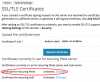
3. Then go to Tools & Settings > SSL/TLS Certificates and set your certificate on "Certificate for securing Plesk" option.
4. Logout, reload and login.

Screenshot at янв. 10 10-13-43.png

Also you can install the Plesk Security Advisor extension in the Extensions menu in Plesk: https://www.plesk.com/extensions/security-advisor/
It will switch on HTTPS (SSL) & HTTP/2 for all domains on the server and secures Plesk itself. Also it takes care of migrating WordPress sites to HTTPS.
 
Hi IgorG,

thank you for your replay. Then I will have to inform myself about Onyx, and findout the diffrence between it and web pro.

Best regards
 
Back
Top